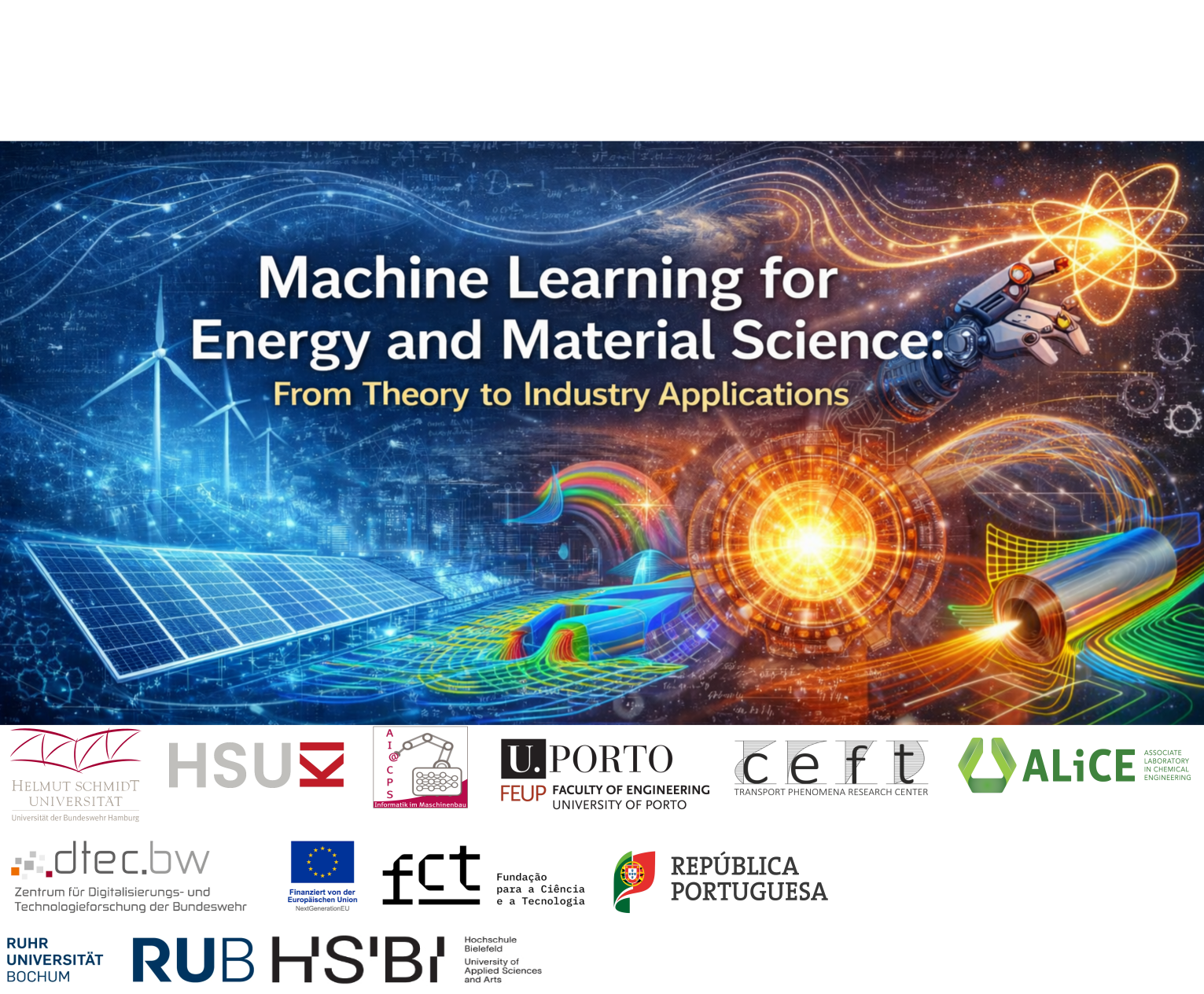
This is a joint workshop merging “ML4EMS: Machine Learning for Energy and Material Science: From Theory to Industry Applications” and “International Workshop on Machine Learning for Scientific Discovery in Advanced Materials”.
Advances in energy systems, advanced materials, manufacturing, and climate science increasingly depend on the ability to model and optimise complex physical processes across multiple spatial and temporal scales. These systems are typically governed by coupled, nonlinear dynamics described by partial differential equations and multi-physics models, whose numerical simulation can be computationally expensive and difficult to scale.
Machine learning is rapidly transforming scientific computing and materials research by enabling data-driven and physics-informed approaches for modelling, simulation, optimisation, and discovery. Recent advances — including physics-informed learning, neural operators, differentiable solvers, surrogate modelling, generative methods, and uncertainty-aware learning — are opening new possibilities to accelerate high-fidelity simulations, improve predictive accuracy and robustness, and enable real-time decision-making in complex physical and engineering systems. These developments support scalable modelling strategies that integrate computational simulations, experimental observations, and domain knowledge to address challenges in multi-physics and multi-scale scientific applications.
This workshop brings together researchers from machine learning, applied mathematics, physics, chemistry, and engineering working on scientific machine learning methods and their applications to complex physical systems, energy systems, and advanced materials discovery. The focus includes hybrid modelling approaches that integrate computational simulations, experimental data, and scientific knowledge, as well as strategies for learning under data-scarce and high-cost experimental conditions across domains such as sustainable energy, climate modelling, manufacturing, and functional materials design.
The workshop aims to foster interdisciplinary collaboration and to promote the development of AI methodologies that enable improved understanding, prediction, and optimisation of physical processes, support inverse design and accelerated materials innovation, and contribute to technological challenges in sustainable energy, manufacturing, climate modelling, and functional materials development.
We invite submissions from academia, industry, and national laboratories presenting novel machine learning methodologies, theoretical advances, hybrid modelling frameworks, and real-world applications addressing challenges in scientific machine learning and materials discovery.
Format: Half-day workshop with paper presentations and a keynote talk.
Audience: Researchers, engineers, and data scientists from academia, industry, and national laboratories working on scientific machine learning, materials informatics, physics-informed modelling, hybrid simulation–experiment workflows, and data-efficient AI methods for complex physical systems in energy, materials, climate, and advanced manufacturing.
Important Dates
- Abstract submission deadline: 05/06/2026
- Paper submission deadline: 12/06/2026
05/06/2026 - Decision notification: 04/07/2026
- Workshop date: 11/9 morning
Organisers
- Cecília Coelho — Helmut Schmidt University, Hamburg, Germany
- Doaa Mohamed — Interdisciplinary Centre for Advanced Materials Simulation, Ruhr University Bochum, Bochum, Germany
- Luís Ferrás — University of Porto, Porto, Portugal
- María Ortiz de Zuniga — Fusion for Energy (F4E)
- Oliver Niggemann — Helmut Schmidt University, Hamburg, Germany
- Markus Stricker — Interdisciplinary Centre for Advanced Materials Simulation, Ruhr University Bochum, Bochum, Germany
- Alaa Tharwat — Bielefeld University of Applied Sciences and Arts (HSBI), Bielefeld, Germany
- Lei Zhang — Interdisciplinary Centre for Advanced Materials Simulation, Ruhr University Bochum, Bochum, Germany
- Thomas Philipp Zimmermann — Bielefeld Institute of Applied Materials Research, Bielefeld University of Applied Sciences and Arts, Bielefeld, Germany
- Elzbieta Stepula — Bielefeld Institute of Applied Materials Research, Bielefeld University of Applied Sciences and Arts, Bielefeld, Germany